
Extended Workforce Solutions: Designing Agility into Your Workforce Strategy
Extended workforce solutions for enterprises are no longer a tactical resourcing choice. They are becoming a defining component of modern enterprise workforce strategy. In a market shaped by AI acceleration, regulatory volatility, geopolitical uncertainty and continuous digital transformation, organisations are reassessing how capability is structured, deployed and governed.
For more than a decade, agility has been framed as a cultural ambition. Enterprises have invested in agile methodologies, cross-functional models and leadership development in pursuit of responsiveness. Yet many still struggle to execute transformation at speed, scale specialist expertise during demand spikes or respond decisively to regulatory change.
The constraint is rarely intent. It is architecture.
In operating environments, enterprise workforce strategy must evolve beyond static headcount planning. Extended workforce solutions for enterprises provide a structural mechanism to embed flexibility, manage workforce risk and align capability with strategic cycles rather than fixed organisational design.
The Limits of Traditional Enterprise Workforce Strategy
Most enterprise workforce strategy frameworks were built for predictability. Long planning cycles, stable demand curves, and gradual technological changes made fixed headcount the natural basis for capability building.
But with volatility becoming structural rather than cyclical, the enterprise workforce strategy framework needs to factor in scalable frameworks that enable capability to adapt to transformation and risk dynamics.
FTE-heavy frameworks bring rigidity to three key dimensions:
1. Capital Rigidity
The workforce cost base is now effectively fixed, limiting financial flexibility in downturns and necessitating long-term commitments before validating growth plans.
2. Execution Delays
Hiring cycles and ramp times delay the application of specialized capability, further fragmenting the gap between strategy and execution.
3. Workforce Risk Exposure
Sudden changes in skills demand, especially in AI, cybersecurity, digital platforms, and regulatory environments, raise the risk of misaligned capability and underutilised fixed headcount.
These factors do more than affect the enterprise. They shape strategic confidence. With workforce scalability constrained, the leadership team must temper strategy to align with structural capabilities.
Agility cannot be superimposed on rigidity.
Stability vs Elasticity in Enterprise Workforce Models
To grasp the strategic benefit of extended workforce solutions for enterprises, it is useful to contrast structural models side by side.
| Dimension | Traditional FTE-Dominant Model | Extended Workforce Model |
|---|---|---|
| Cost Structure | Primarily fixed long-term commitments | Balanced fixed and variable capability cost |
| Workforce Scalability | Limited and slow to adjust | Designed for rapid scaling up or down |
| Speed to Specialist Capability | Dependent on recruitment timelines | Accelerated deployment of proven expertise |
| Response to Market Volatility | High financial and operational exposure | Controlled elasticity aligned to demand |
| Transformation Capacity | Competes with business-as-usual workloads | Dedicated programme-aligned capability |
| Workforce Risk Management | Skills may become obsolete or misaligned | Flexible access to evolving expertise |
This comparison demonstrates how extended workforce models provide structural agility and financial flexibility in dynamic environments.
The aim is not to displace core employees. Core capability underpins governance, institutional knowledge, and strategic continuity.
The aim is to add managed elasticity, a flexible workforce model that can absorb volatility without undermining the enterprise core.
By design, extended workforce solutions for enterprises can deliver workforce scalability with control of operations
Designing a Flexible Workforce Model for Enterprise Agility
The enterprises that are able to successfully operate in an environment of sustained disruption will typically have four key characteristics of their enterprise workforce strategy:
- Definition of Core and Extended Capability
Strategic and governance-critical skills are retained in-house, while surge, specialist, and transformational skills are designed to be flexible.
- Management of Contingent Workforce
External expertise is managed within a defined framework of compliance, workforce risk management, and reporting, as opposed to a series of disparate contracts.
- Alignment of Workforce Scalability with Capital Strategy
The cost structure of the workforce is able to flex with program lifecycles, improving capital efficiency and minimising long-term risk.
- Enterprise-Level Oversight and Performance Accountability
Extended capability is measured against business outcomes, providing transparency and maximising impact.
This is a move from workforce ownership to workforce orchestration. Instead of retaining all capabilities in-house, organisations are designing systems that enable the composition, deployment, and redeployment of capability in response to strategic needs.
In this approach, enterprise workforce strategy is no longer static but dynamic.
These factors are more than just operational. They shape strategic confidence. When faced with a lack of workforce scalability, leadership teams temper ambition with structural capacity.
Agility cannot be layered on top of rigidity.
Choosing the Right Extended Workforce Solutions Partner
Adopting extended workforce solutions for enterprises requires more than access to talent. It requires governance, integration and accountability at enterprise scale.
Many organisations rely on fragmented contingent workforce management approaches or multi-vendor supplier panels. While these may provide access to skills, they often lack structural cohesion. Without integrated oversight, compliance alignment and performance governance, workforce flexibility can introduce operational complexity and unmanaged risk.
An enterprise-grade extended workforce solution must operate as a managed system.
At SureSkills, we provide structured extended workforce solutions to enterprises that combine rapid access to specialist talent with governance discipline and performance management oversight. Our approach enhances enterprise workforce strategy, rather than co-existing with it.
This is achieved through:
- Governed Delivery Frameworks
Extended talent is brought into alignment with enterprise compliance, regulatory, and reporting needs, so that workforce flexibility does not undermine risk management practices. - Curated Specialist Expertise
At SureSkills, we retain high-quality access to domain specialists in digital transformation, technology, regulation, and operations, to rapidly deploy specialist capability. - Integrated Performance Management
Engagements are tracked for programme outcomes, so that accountability and value creation are preserved.
- Scalable Enterprise Support
Whether supporting system implementation, AI integration, regulatory reform or transformation initiatives, SureSkills provides workforce scalability without inflating permanent headcount.
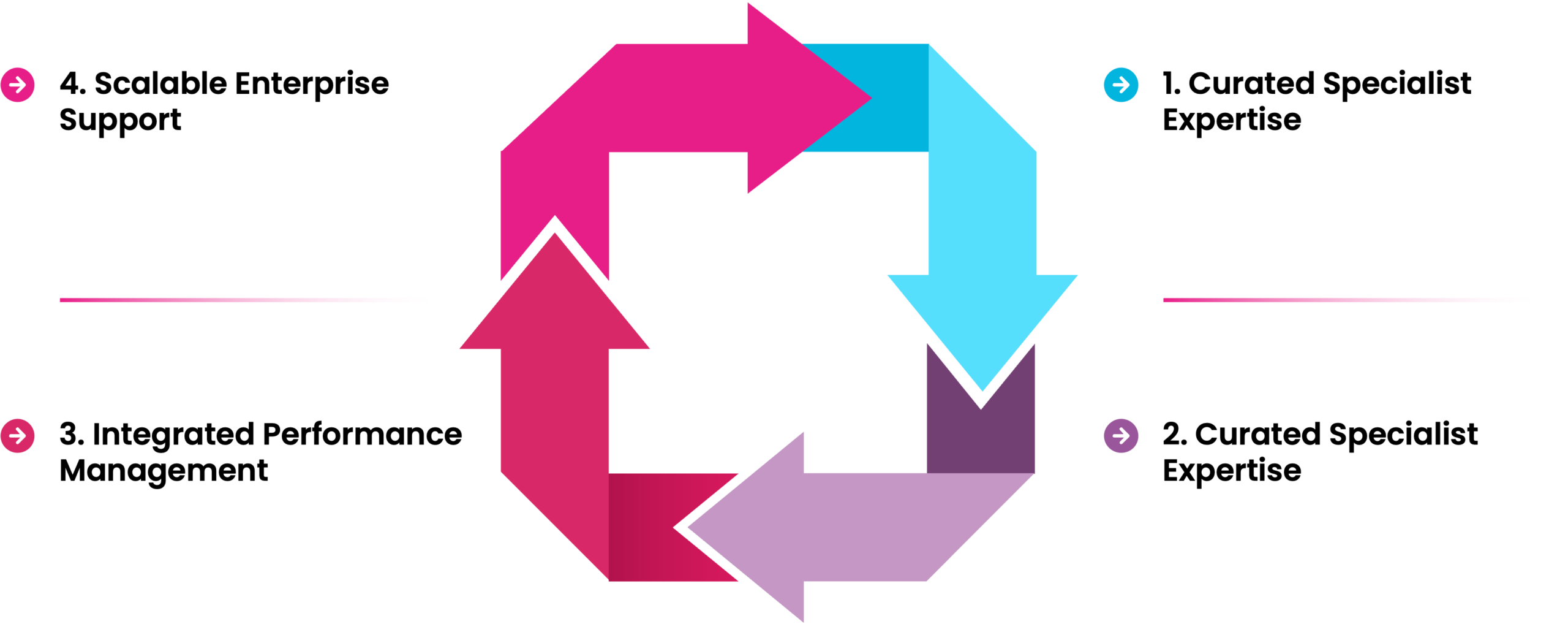
The distinction is structural. SureSkills does not simply augment teams. It embeds controlled elasticity into enterprise workforce strategy, enabling agility while protecting institutional stability.
For executive teams balancing growth, risk exposure and capital allocation, that balance is critical.
Ready to Reassess Your Enterprise Workforce Strategy?
Volatility is not temporary. The question is whether your workforce architecture is designed to absorb it.
If you are evaluating how to embed greater agility, workforce scalability and risk control into your operating model, SureSkills can provide a structured review of your current enterprise workforce strategy and identify where controlled elasticity can unlock execution advantage.
Speak with our enterprise workforce specialists to explore how extended workforce solutions for enterprises can strengthen your operating model.
Frequently Asked Questions About Extended Workforce Solutions
Q: What are extended workforce solutions for enterprises?
A: Extended workforce solutions for enterprises are structured models that enable organisations to access specialist and scalable capability beyond permanent headcount while maintaining governance, compliance and performance oversight.
Q: How do extended workforce solutions improve enterprise workforce strategy?
A: They introduce workforce scalability and rapid access to specialist expertise, reducing execution delays and aligning capability deployment with strategic transformation cycles.
Q:What is the difference between contingent workforce management and an extended workforce model?
A: Contingent workforce management often focuses on contractor administration and procurement. An extended workforce model integrates external capability strategically into enterprise workforce strategy, aligning it with governance, risk management and measurable business outcomes.
Q: How do extended workforce solutions reduce fixed headcount risk?
A:By balancing permanent employees with scalable external capability, enterprises reduce long-term cost commitments while retaining the flexibility to scale programmes in response to demand shifts.