
How Businesses Can Use Blockchain in 2026
In 2026, blockchain is no longer a futuristic experiment. Businesses are increasingly using blockchain, not to look innovative, but to eliminate friction, automate trust, and redesign how value moves across industries. The biggest shift is that businesses exploring blockchain in 2026 are asking:
“Which parts of our operations still depend on slow trust systems?”
This article explores how modern businesses can use blockchain in 2026 in practical, profitable, and scalable ways beyond cryptocurrency.
The New Reality of Blockchain in 2026
Early blockchain adoption focused heavily on speculation, including coins, NFTs, trading, and memecoins. However, the second wave is centred on enterprise utility. Today, blockchain is increasingly used as a trust operating system, a shared business database, an automation engine, a verification network, and a digital ownership layer. In simple terms, blockchain helps businesses reduce the need for middlemen, paperwork, manual approvals, and data disputes.
Why Blockchain Matters More in 2026 Than Before
Three major changes have happened globally:
- AI has increased the need for verification. It can now generate fake invoices, fake contracts, fake identities, fake videos, and fake certifications. As a result, blockchain can provide an additional verification layer for some business processes.
- Global commerce has become more distributed. Remote work, international freelancers, digital products, and global vendors have created complex transaction systems. Blockchain helps simplify cross-border coordination in this environment.
- Customers have started demanding more transparency. Consumers now expect ethical sourcing, authentic products, verified sustainability claims, proof of ownership, and greater control over their data. Blockchain helps support all of these expectations.
The 7 Business Layers Blockchain Is Transforming
Instead of thinking industry-by-industry, smart companies in 2026 think function-by-function. Blockchain impacts seven core business layers:
| Business Layer | Blockchain Benefit |
|---|---|
| Payments | Faster settlement |
| Contracts | Automated execution |
| Supply Chain | Improved traceability |
| Identity | Fraud reduction |
| Data Sharing | Tamper-resistant records |
| Loyalty | Portable rewards |
| Ownership | Tokenised assets |
Smart Contracts: The Silent Workforce
A key enterprise use case in 2026 is smart contracts. A smart contract is software that automatically executes agreements when predefined conditions are met. For example, a supplier delivers goods, an IoT sensor confirms the arrival, and the payment is released automatically. This process can reduce the need for manual accounting, bank delays, and lengthy approval chains.
Businesses Using Smart Contracts
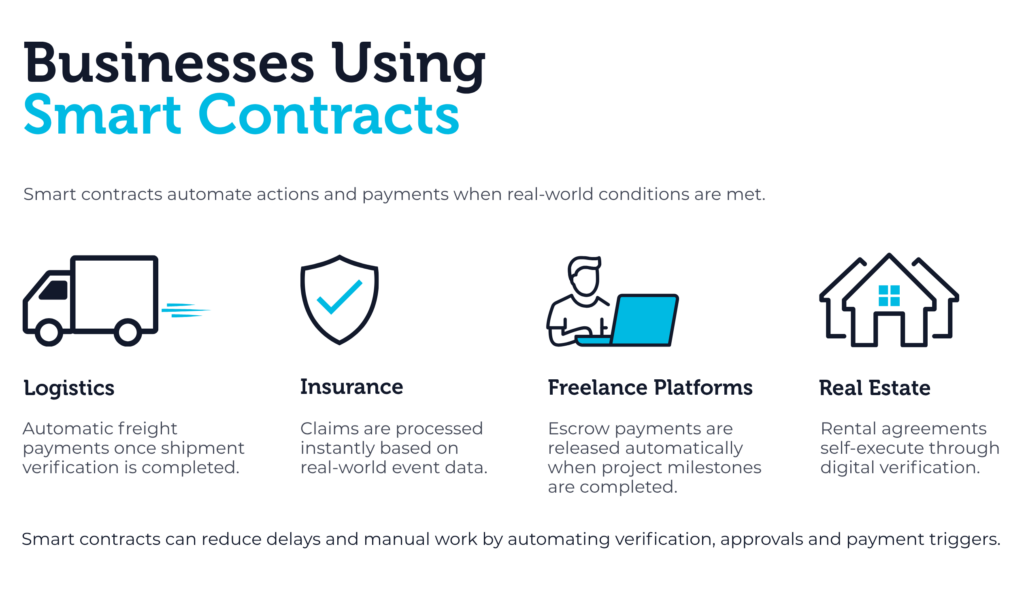
Logistics companies use blockchain to enable automatic freight payments once shipment verification is completed. Insurance firms use it to process claims instantly based on real-world event data. Freelance platforms rely on smart contracts to release escrow payments automatically when project milestones are completed. Real estate firms also use blockchain to create rental agreements that self-execute through digital verification.
Supply Chain Transparency Became a Competitive Advantage
In 2026, customers no longer rely on labels alone for trust. Instead, businesses are expected to prove details such as product origin, manufacturing history, sustainability metrics, carbon footprint, and ethical sourcing using blockchain records.
For example, a coffee company can demonstrate exactly which farm produced the beans, the harvest date, transport conditions, warehouse handling, and roasting timeline, with all steps recorded through blockchain checkpoints. This level of transparency helps build stronger consumer trust, enables premium pricing opportunities, and reduces the risk of counterfeit products.
Blockchain + AI = Autonomous Business Systems
One of the biggest trends in 2026 is the integration of AI with blockchain. In this model, AI is responsible for creating decisions, while blockchain is used to verify and record them. Together, they are transforming how operations are managed across industries.
For example, an AI system may predict inventory shortages, and blockchain can then automatically place supplier orders, validate contract terms, trigger payments, and permanently record the transaction. This combination enables the development of autonomous commerce systems.
Tokenisation: Turning Assets into Digital Liquidity
Tokenisation is gaining attention in 2026, with businesses now converting real-world assets into digital representations on the blockchain. These assets include real estate, intellectual property, music royalties, luxury goods, carbon credits, stocks, commodities, and event tickets.
Businesses favour tokenisation for several reasons. It enables fractional ownership, allowing a $10 million property to be divided into thousands of digital shares. It also provides faster liquidity by making assets easier to trade globally. In addition, it lowers entry barriers, allowing smaller investors to participate, and creates new revenue models by helping businesses monetise assets that were previously illiquid.
Decentralised Identity Changed Customer Verification
Blockchain-based identity systems are becoming more widely used for digital verification in 2026. These systems allow users to control their personal data, share only the required information, and verify their credentials digitally.
For example, instead of uploading documents such as a passport, utility bill, or driving licence, customers can simply approve a cryptographic verification request. This shift also benefits businesses by reducing fraud, speeding up customer onboarding, and lowering compliance costs.
Blockchain Loyalty Programmes Offer an Alternative to Traditional Points
Traditional loyalty systems have significant limitations, as points often expire, rewards remain locked within a single ecosystem, and users rarely redeem them. Blockchain has changed these loyalty economics.
In 2026, modern loyalty systems allow customers to trade, transfer, and use rewards across partner ecosystems, as well as convert them into digital assets.
For example, a hotel chain, an airline, and a retail brand can operate within a shared, interoperable reward network, which significantly increases customer engagement.
Healthcare Businesses Are Using Blockchain for Trust Infrastructure
Healthcare has become an important sector for blockchain adoption. Key use cases include secure and portable patient records that allow medical histories to be accessed safely across providers, drug verification systems that track pharmaceuticals from factory to pharmacy, insurance automation where claims are verified through smart contracts, and research integrity where clinical trial data is tamper-resistant.
Overall, these applications can help reduce fraud, administrative waste, and data silos across the healthcare ecosystem.
Manufacturing Companies Are Creating “Digital Twins”
A major innovation in 2026 is blockchain-connected digital twins. A digital twin is a digital representation of a physical object that mirrors its real-world condition and behaviour.
Manufacturers can use these systems to track machine health, service history, component replacements, and the full ownership lifecycle through blockchain records. This improves predictive maintenance by identifying issues before failures occur, enhances warranty management through accurate service tracking, and strengthens resale authentication by verifying the complete history of the asset.
Small Businesses Can Finally Use Blockchain Without Developers
In the past, blockchain adoption required specialised engineers, expensive infrastructure, and complex integrations. However, this is becoming less of a barrier. In 2026, the introduction of no-code blockchain tools, plug-and-play APIs, blockchain SaaS platforms, and AI-assisted smart contract builders has significantly lowered the barrier to entry.
As a result, even small businesses can now verify invoices, track inventory, create loyalty tokens, and automate agreements without needing to write any code.
Blockchain Can Reduce Reliance on Middlemen
This represents one of the deepest transformations. Blockchain reduces dependence on banks, escrow providers, verification agencies, record keepers, clearing houses, ticket brokers, and intermediary marketplaces. It does not do this by eliminating trust, but by digitising trust, making verification and enforcement part of the system itself rather than relying on external intermediaries.
Industries Using Blockchain
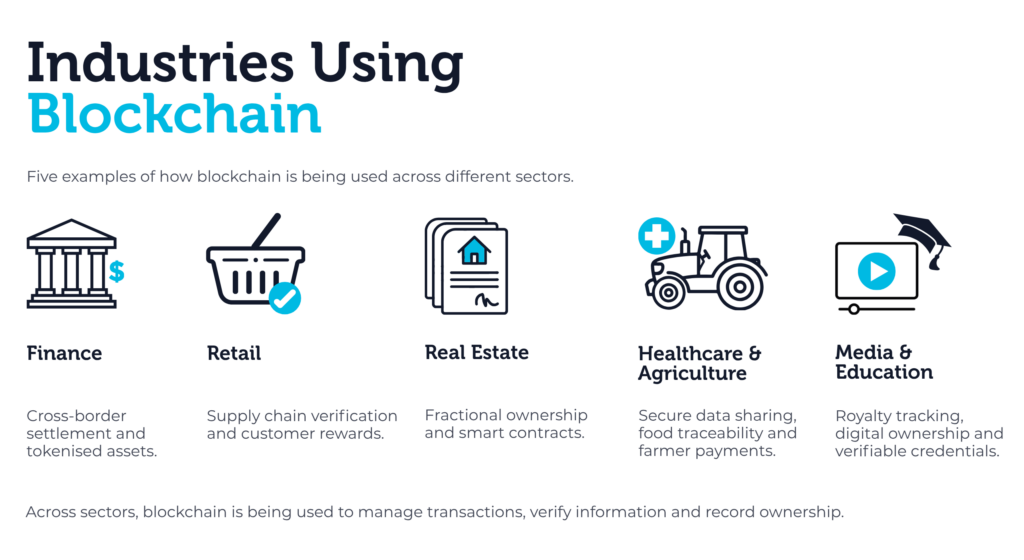
- Finance uses blockchain for cross-border settlement and tokenised assets.
- Retail applies it for supply chain verification and customer rewards.
- Real estate uses it for fractional ownership and smart contracts.
- Healthcare uses it for secure data sharing, while agriculture can use it for food traceability and farmer payments.
- In media, blockchain supports royalty tracking and digital ownership, and in education, it enables verifiable certifications and credentials.
The Hidden Business Benefits Most Companies Ignore
Most businesses focus only on automation, but blockchain’s biggest long-term value comes from broader structural improvements:
- Simplifies auditing because tamper-resistant records reduce compliance friction and make verification easier.
- Reduces disputes by providing a shared and transparent transaction history that minimises conflicts between parties.
- Strengthens brand trust, as transparency itself becomes a marketable advantage.
- Increases operational speed by enabling processes to happen in real time without multiple intermediaries.
Finally, it can improve global accessibility, since blockchain systems can support cross-border activity more easily than some traditional systems.
Challenges Businesses Still Face in 2026
Blockchain is powerful, but it is not magic. It still faces several challenges that limit its full-scale adoption. Scalability remains an issue, as some networks struggle to handle massive transaction loads efficiently. Regulation is another challenge, with global compliance standards still fragmented across different regions. User education is also a barrier, since many customers and businesses do not yet fully understand how blockchain systems work. Integration complexity adds further difficulty, as legacy systems are often hard to modernise and connect with blockchain infrastructure. Finally, security risks persist, because vulnerabilities in smart contracts can still lead to financial losses.
The Smartest Blockchain Strategy in 2026
Businesses are not “going all in” on blockchain; instead, they are using it selectively. A practical strategy begins by identifying trust bottlenecks within operations. Next, businesses automate workflows that require verifiable and tamper-resistant records. They then apply blockchain only in areas where shared transparency truly adds value. After that, they combine AI and blockchain to enable intelligent automation across processes. Finally, they focus on improving customer experience rather than chasing technology buzzwords.
What Blockchain Could Look Like by the End of 2026
The biggest prediction is that most customers will use blockchain without even realising it. Just like people already use cloud computing, APIs, encryption, and databases without actively thinking about them, blockchain is moving in the same direction. It is gradually becoming an invisible layer of infrastructure that powers applications and services in the background, rather than something users directly interact with or notice.
Written by [Author Name], [Job Title], SureSkills Pune.